Domenico De Fazio

Skin-safe, flexible photodetectors combine graphene and carbon dots for wearable sensing

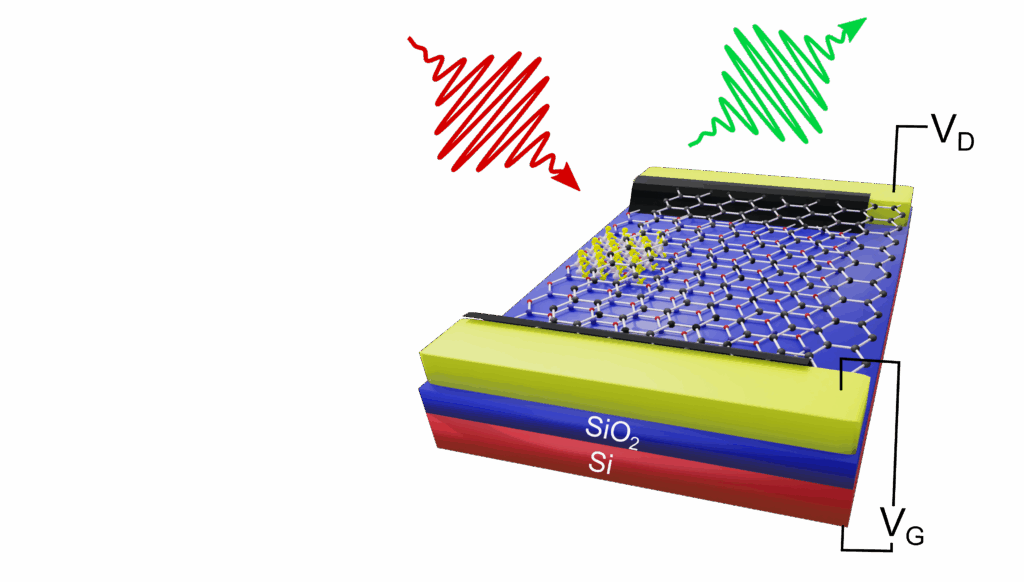
Researchers from Ca’ Foscari University of Venice, working within the SUPERVenice research unit, have developed a new type of flexible, skin-compatible photodetector that can sense light across a broad range of wavelengths while operating at low voltage and remaining safe for direct contact with human skin. The device, reported in Advanced Functional Materials, combines graphene with specially engineered carbon dots on a plastic substrate, creating a lightweight and bendable photodetector suitable for wearable electronics and on-skin sensing applications. Addressing a key challenge in wearable optoelectronics Photodetectors—devices that convert light into electrical signals—are essential components in technologies ranging from cameras and optical communications to medical sensors. Conventional photodetectors, often based on rigid silicon electronics, perform well but are poorly suited for wearable or skin-integrated systems, where flexibility, low power consumption and biocompatibility are crucial. Many flexible photodetectors reported to date compromise on at least one of these requirements. Some offer high sensitivity but rely on toxic materials such as lead- or cadmium-based quantum dots; others are flexible but operate over a narrow spectral range or lack evidence of skin safety. The new work addresses these limitations by combining broadband optical response, mechanical flexibility and verified skin compatibility within a single device architecture. Carbon dots and graphene: complementary roles The photodetector is built by integrating hydrothermally synthesized carbon dots with single-layer graphene transferred onto a polyethylene terephthalate (PET) substrate. The carbon dots act as the light-absorbing element, while graphene provides an efficient, high-mobility pathway for charge transport. Unlike conventional quantum dots, the carbon dots used in this study are metal-free, environmentally benign and inherently biocompatible. By carefully tuning their synthesis conditions, the researchers engineered the dots to absorb light not only in the ultraviolet but also across the visible and near-infrared range, extending roughly from 400 to 800 nanometers. Graphene alone absorbs only a small fraction of incoming light, but when coupled to the carbon dots it efficiently collects photogenerated charge carriers, enabling a measurable electrical response across the full spectral window. Low-voltage operation with a biopolymer gate To control the device electronically, the team used a chitosan–glycerol biopolymer electrolyte as a gate dielectric. Chitosan, derived from natural sources such as chitin, is non-toxic and widely used in biomedical applications. This electrolyte enables strong electrostatic gating at very low operating voltages, with optimal performance reached at around 0.5 V, well below the levels typically required by flexible photodetectors. Under illumination, the device shows a gate-dependent photoresponse that can be tuned between different operating regimes, with peak responsivities of approximately 0.19 A/W at 406 nm, 0.32 A/W at 642 nm, and 0.18 A/W at 785 nm. Performance under bending and repeated use Mechanical flexibility is a key requirement for wearable electronics, and the researchers subjected their devices to extensive bending tests. The photodetectors maintained stable operation at bending radii as small as 0.8 cm and showed no significant degradation after up to 1000 bending cycles. The response times, on the order of one second, are compatible with many wearable sensing applications, including biometric monitoring and environmental light sensing. Demonstrated skin compatibility Beyond electrical and mechanical performance, the study directly addresses skin safety, an aspect often assumed rather than tested in wearable optoelectronics. Using reconstructed human epidermis models and fibroblast cultures, the researchers showed that neither the complete device nor its individual components caused skin irritation or cytotoxic effects. Importantly, illumination under realistic operating conditions did not induce detectable reactive oxygen species (ROS) generation, indicating that the device is photo-safe for on-skin use. Toward practical wearable photonics While the device is presented as a proof of concept, the authors emphasize that the materials and fabrication steps are compatible with scalable, low-cost processing. Future work will focus on improving detectivity, optimizing large-area uniformity, and integrating the photodetectors into functional wearable platforms. By combining metal-free light absorbers, graphene electronics, biopolymer gating and direct biological testing, the study outlines a practical route toward next-generation photodetectors designed from the outset for safe, wearable operation. The full study is published in Advanced Functional Materials and is available at https://doi.org/10.1002/adfm.202523076

Skin-safe, flexible photodetectors combine graphene and carbon dots for wearable sensing Read More »

Venice shines bright for the FISMAT 2025 conference

From July 6 to 11, 2025, the historic San Giobbe Economics Campus of Ca’ Foscari University welcomed over 1,100 attendees from across the globe for FISMAT 2025, a landmark gathering on the “physics of matter” (eventi.cnism.it). The state‑of‑the‑art venue—with its 23,000 m² dedicated to research, teaching, and relaxation in its lush 2,000 m² garden—offered the perfect backdrop for a conference that exceeded all expectations. The event featured a robust program of invited talks, contributed sessions, and stimulating workshops, including a spotlight on the ISOL technique for medical radionuclide production (LinkedIn). Prominent scientists from institutions like EPFL, Max Planck, Università di Milano, and the Goethe Universität gathered in the Cannaregio district to present cutting-edge research, network, and forge collaborations. Figures of Merit: Attendance: Over 1,100 participants—well beyond initial estimates Speakers: A stellar international lineup, spanning physics, math, and engineering Venue: Conveniently located near Santa Lucia station and Piazzale Roma, with excellent water‑bus connections A Night to Remember: Dinner at Palazzo Moro On Wednesday evening, attendees gathered at the opulent Palazzo Moro, an elegant 16th-century palace nestled in the Cannaregio district. Built by the Moro-Bizio family, this Venetian gem is renowned for its Renaissance façades and frescoed interiors. The palace provided a magical setting for the conference dinner, where guests enjoyed fine Venetian cuisine and heartfelt conversations under shimmering chandeliers. Against the backdrop of historic frescoes, colleagues deepened connections over prosecco, seafood risotto, and local desserts—truly a Venetian feast. What’s Next? With such resounding success, FISMAT 2025 has firmly positioned Venice as a hub for high‑caliber scientific exchange. Attendees departed inspired, carrying with them both fresh insights and unforgettable memories of our city’s magic.   📸 Sneak Peeks from FISMAT 2025 📸 Thank you to everyone—organizers, speakers, sponsors, and attendees—who helped make FISMAT 2025 a shining success. Venice awaits even more groundbreaking discoveries next time!  

Venice shines bright for the FISMAT 2025 conference Read More »

Graphene Meets MoS₂: New Path to Control Light at the Nanoscale

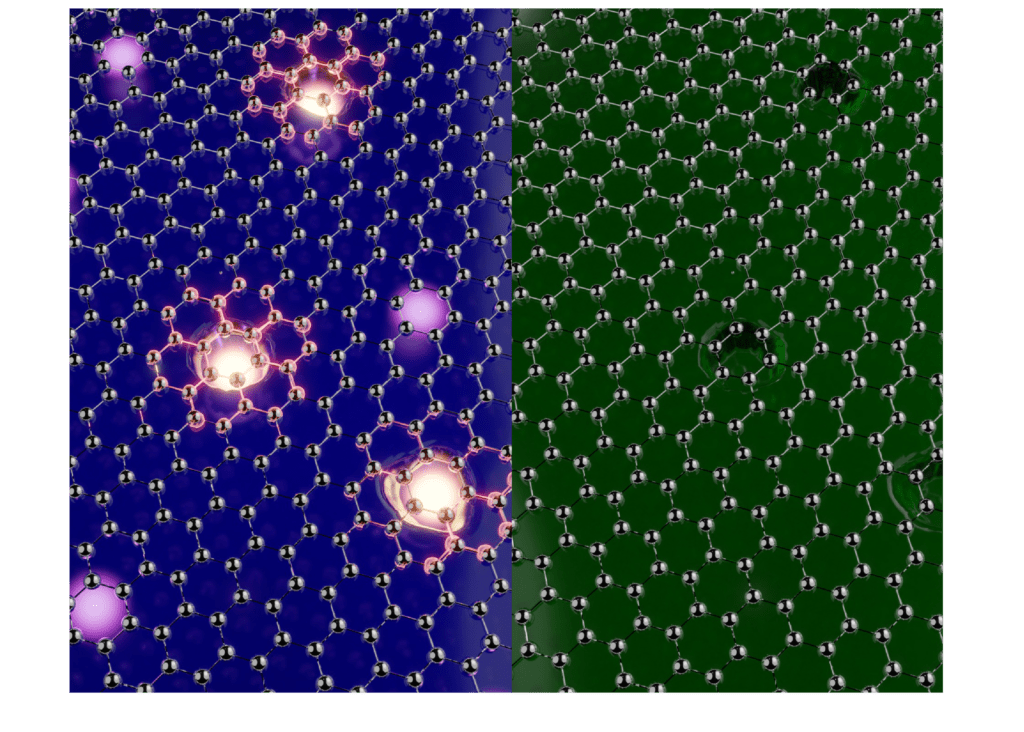
In a study just published in ACS Nano, the team investigated what happens when monolayer MoS₂ — a direct-gap semiconductor just three atoms thick — is stacked with graphene. This combination of two-dimensional (2D) materials reveals a subtle but powerful mechanism: electrical control over light emission without relying on high levels of doping. By carefully tuning the interaction between MoS₂ and graphene, the researchers observed a dramatic suppression of photoluminescence (light emission) from specific exciton species (bound electron-hole pairs), depending on whether the material was isolated or part of a stacked heterostructure. The introduction of graphene changes the game: it enables efficient, voltage-controlled charge transfer, preventing the accumulation of excess carriers in MoS₂ and thus keeping the optical response stable and predictable. The most striking insight? In pristine MoS₂, high doping leads to a superlinear increase in light emission — a kind of optical “amplification” that stops once the system is saturated. This effect disappears completely in the MoS₂/graphene stack, showing that graphene acts as a natural “exciton regulator,” draining away excess charge and suppressing this nonlinearity. Even B-type excitons — typically unaffected by doping due to their ultrafast decay — are modulated by this setup, revealing that charge transfer occurs before excitons can recombine internally. This suggests the presence of a hot-electron transfer channel, a new dimension to 2D material photophysics. Why it matters This work opens the door to more precise control over how atomically thin materials emit light, essential for developing efficient LEDs, photodetectors, and quantum light sources. The use of layered 2D materials to achieve such control, without chemical treatment or structural modification, marks a significant leap forward in optoelectronics and nanophotonics. The SUPERVenice perspective This discovery strengthens Venice’s growing role in frontier materials research. The participation of Ca’ Foscari University through Prof. Domenico De Fazio, member of SUPERVenice, highlights the impact of collaborative, interdisciplinary science rooted in fundamental physics with clear technological implications. The full paper, “Tunable Exciton Modulation and Efficient Charge Transfer in MoS₂/Graphene van der Waals Heterostructures”, is available open-access in ACS Nano. 🔬 Read the paper: ACS Nano DOI

Graphene Meets MoS₂: New Path to Control Light at the Nanoscale Read More »

SUPERVenice Shines at Orientation Event

On January 17, 2025, SUPERVenice, the group of engineering and physics innovators, left a lasting impression at the sixth edition of Professione Scienziate. Held at the Alfa Building on the Ca’ Foscari Science Campus in Venice, the event was a platform to showcase the fascinating and practical aspects of STEM fields to high school students from across the region. This year’s event was particularly successful, with SUPERVenice captivating hundreds of visitors with their engaging and hands-on demonstrations. The SUPERVenice stand drew significant attention, showcasing a range of interactive experiments designed to inspire and educate. Among the highlights: The SUPERVenice team’s innovative approach drew large crowds throughout the event, with students and teachers alike praising the accessibility and excitement of the presentations. Beyond simply entertaining, these demonstrations effectively communicated the practical and transformative power of engineering physics, igniting interest among students who are now considering enrolling in the bachelor’s and master’s programs in Engineering Physics at Ca’ Foscari. The event marked a significant milestone in the orientation efforts aimed at encouraging high school students to pursue STEM careers. SUPERVenice’s ability to bridge complex scientific concepts with engaging and relatable demonstrations solidified its reputation as a leader in fostering the next generation of engineers and physicists. As the enthusiasm from Professione Scienziate fades into memory, SUPERVenice looks forward to welcoming these inspired students to its programs, where they will embark on a journey of discovery and innovation. Event Link: https://www.unive.it/data/agenda/6/96921

SUPERVenice Shines at Orientation Event Read More »

Unlocking the Potential of Deep Eutectic Solvents in Hydrogen-Based Superconductors

  Hydrogen-rich materials are paving the way for breakthroughs in superconductivity, but the path to efficiently incorporating hydrogen into these materials has been fraught with challenges. Our recent study, published in the Journal of Molecular Liquids, unveils a transformative method for hydrogen loading using deep eutectic solvents (DES), which promises to revolutionise this field. Led by a collaborative team of researchers from Politecnico di Torino, the Ca’ Foscari University of Venice and other institutions, the study demonstrates how a simple mixture of choline chloride and glycerol can replace the traditionally used ionic liquids for hydrogen incorporation. This innovative approach addresses key issues such as cost, toxicity, and environmental impact while achieving hydrogen concentrations high enough to induce superconductivity in palladium. The concept hinges on ionic gating-induced protonation (IGP), a technique that uses an electric field to drive hydrogen ions into materials. By leveraging the unique properties of DES—low viscosity, biodegradability, and cost-effectiveness—the researchers successfully injected hydrogen into palladium bulk foils and thin films, achieving a stoichiometry of up to PdH₀.₈₉. While partial superconducting transitions were observed in thin films, the study underscores the need for further refinement to ensure a uniform hydrogen distribution within materials. Beyond Palladium: A Vision for the FutureThough the research focuses on palladium as a model system, its implications extend far beyond. The DES-based IGP method could be adapted for a wide range of materials, offering promising applications in hydrogen storage, spintronics, and quantum technologies. This breakthrough aligns with global efforts to develop more sustainable and accessible superconducting technologies at practical pressures and temperatures. This groundbreaking study represents a significant leap forward in material science, potentially heralding a new era of innovation. For more details, you can access the full article in the Journal of Molecular Liquids: https://doi.org/10.1016/j.molliq.2024.126826.  

Unlocking the Potential of Deep Eutectic Solvents in Hydrogen-Based Superconductors Read More »

Ca’ Foscari Ranks in Top 250 for Interdisciplinary Science

Ca’ Foscari University of Venice has earned a spot among the top 250 universities worldwide in the inaugural edition of the Interdisciplinary Science Rankings (ISR) by Times Higher Education. This new ranking highlights the university’s excellence in fostering interdisciplinary research across Life Sciences, Physical Sciences and Engineering. The ISR evaluates over 700 universities from 92 countries, focusing on their ability to address complex global challenges through the integration of diverse fields of knowledge. By emphasizing a complementary approach to combining scientific expertise, the rankings spotlight institutions making significant strides in interdisciplinary collaboration. Performance is assessed in three key areas: inputs, which consider funding capabilities; process, encompassing facilities, administrative support, and promotion efforts; and outputs, focusing on publication quality, research impact, and institutional reputation. Ca’ Foscari stands out particularly in the outputs category, achieving a score of 48 points for its high-quality interdisciplinary publications and strong academic reputation. The university also demonstrates notable success in attracting research funding (37.1 points) and providing robust support structures for researchers (33.3 points). These achievements are largely attributed to the work of its two scientific departments: the Department of Environmental Sciences, Informatics and Statistics, and the Department of Molecular Sciences and Nanosystems. The ranking methodology combines data provided directly by universities with bibliometric data from Elsevier, offering a comprehensive picture of how institutions perform in interdisciplinary science. For more information, visit the official Times Higher Education Interdisciplinary Science Rankings.

Ca’ Foscari Ranks in Top 250 for Interdisciplinary Science Read More »

Dr Federico Levi from “Nature” Speaks at Ca’ Foscari

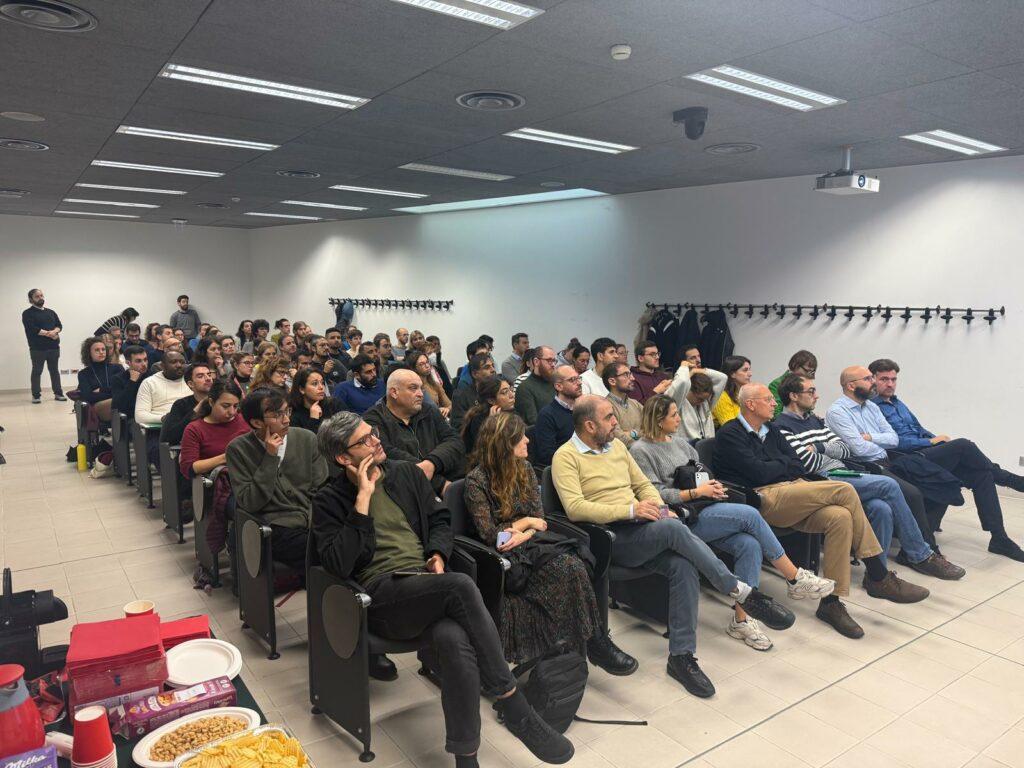
Today, the Department of Molecular Sciences and Nanosystems at Ca’ Foscari University of Venice hosted an insightful talk by Dr Federico Levi, deputy editor at Nature, as part of the Engineering Physics Colloquia. The room was filled to capacity with 90 attendees, and additional participants joined via Zoom, underscoring the significant interest in the topics covered. During his presentation, Levi shed light on several critical aspects of the publishing process at Nature, including their stance on preprint submissions, the role of double-blind peer reviews, the pre-submission enquiry process, and many other topics. One highlight of the discussion was Nature‘s encouragement of preprint submissions to platforms like arXiv, a crucial tool for disseminating early-stage research and receiving feedback. The talk offered a rare glimpse into the journal’s editorial decision-making process, as Levi explained how Nature seeks to publish the most impactful scientific developments while ensuring that they resonate not only with specialized research communities but also with the broader public. His presentation emphasized how influential the journal can be in steering research by focusing on key scientific challenges, reflecting on the kinds of groundbreaking work that get selected for publication. Overall, the event was a great success and provided attendees with valuable insights into the editorial principles that guide Nature. It also opened discussions on the role of high-impact journals in shaping the global research agenda.

Dr Federico Levi from “Nature” Speaks at Ca’ Foscari Read More »

Tungsten Disulfide Emerges as Viable Alternative to hBN

Graphene, the wonder two-dimensional material, has shown exceptional electronic properties, making it a sought-after candidate for various advanced technologies. However, maintaining high carrier mobility in practical device applications has been a challenge, with the choice of substrate and encapsulation playing a pivotal role. A team of researchers, including Dr Domenico De Fazio at the Ca’ Foscari University of Venice, has made a breakthrough in this domain by successfully encapsulating graphene in tungsten disulfide (WS2). This achievement, detailed in a recent paper, offers an alternative to the commonly used hexagonal boron nitride (hBN) encapsulation method. The researchers applied a chemical treatment involving a super-acid, bis(trifluoromethane) sulfonimide (TFSI), to overcome the hysteresis and enhance the mobility of graphene encapsulated in WS2. High mobility, a key requirement for electronic devices, was achieved through WS2 encapsulation, presenting numerous advantages. The study revealed a significant reduction in hysteresis, making WS2-encapsulated graphene a compelling alternative to hBN. This breakthrough has far-reaching implications for various electronic applications, including field-effect transistors, modulators, photodetectors, and sensors. With hBN’s limitations addressed by WS2, the world of graphene-based electronics may soon see significant improvements in performance and scalability, paving the way for more efficient and powerful devices. The full article is available at the following link: https://doi.org/10.1063/5.0151273

Tungsten Disulfide Emerges as Viable Alternative to hBN Read More »

Emmy Noether Lecture Award – Maria Chiara Carrozza

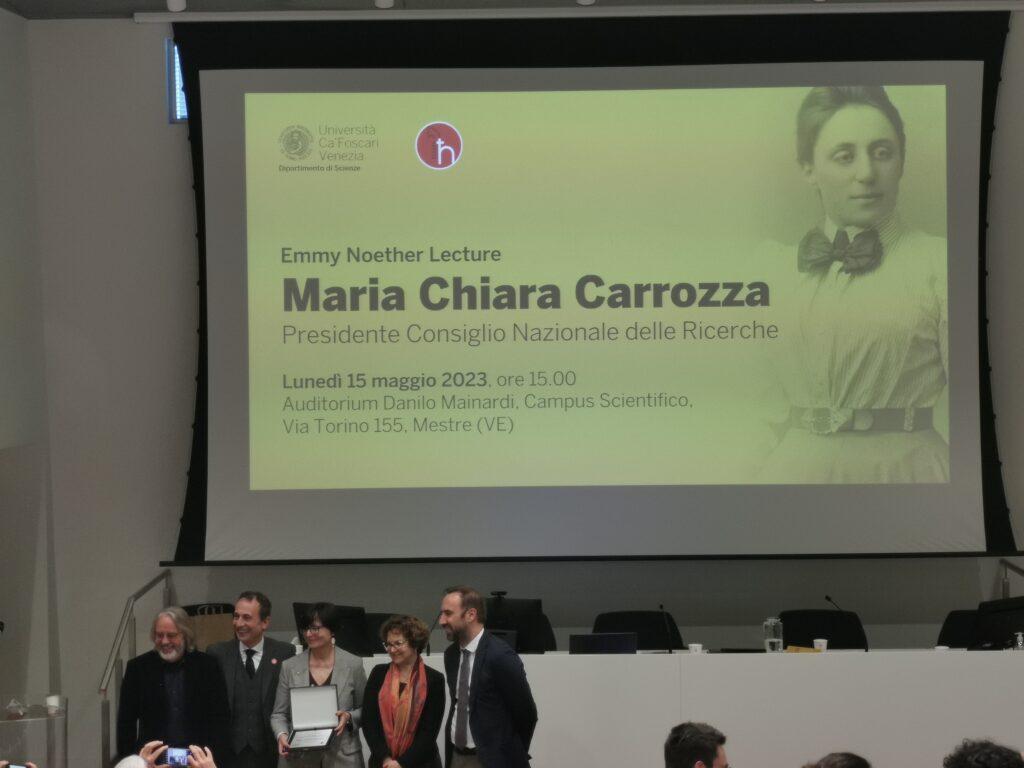
As part of the Engineering Physics colloquia monthly held at the Ca’ Foscari University of Venice, renowned researcher and former Italian minister Maria Chiara Carrozza was honoured with the “Emmy Noether Lecture Award” for her exceptional contributions to the fields of science, technology, and public service. Carrozza, currently serving as the President of the National Research Council of Italy (CNR), was recognized for her groundbreaking work and outstanding leadership in the pursuit of scientific advancements. The Emmy Noether Lecture Award is an accolade which will be presented yearly to individuals who have demonstrated exemplary achievements in the fields of physics and engineering, embodying the spirit of innovation, determination, and societal impact. Named after the pioneering German mathematician Emmy Noether, the award serves as a testament to the recipient’s outstanding intellectual contributions. Carrozza’s illustrious career spans both academia and public service, where she has consistently pushed the boundaries of scientific research while working tirelessly to translate her discoveries into tangible benefits for society. As the President of the CNR, she has played a pivotal role in fostering collaboration between academia, industry, and government to drive innovation and stimulate economic growth. Throughout her career, Carrozza has made significant breakthroughs in the field of robotics and assistive technologies, revolutionising the way we understand human-machine interactions and providing novel solutions to improve the quality of life for individuals with disabilities. Her research has paved the way for advancements in neuroprosthetics, wearable robotics, and rehabilitation engineering, earning her international recognition and acclaim. Carrozza’s exceptional leadership skills and passion for knowledge dissemination have also been instrumental in shaping science and technology policies at both national and international levels. Her previous role as the Italian Minister of Education, University, and Research allowed her to promote scientific literacy and establish strategic partnerships to foster interdisciplinary collaboration and innovation. Upon receiving the prestigious Emmy Noether Lecture Award, Carrozza expressed her deep gratitude and emphasised the importance of interdisciplinary research in addressing the complex challenges of our time. The ceremony at Ca’ Foscari University of Venice was attended by the Rector of the University Tiziana Lippiello, the Director of the Department of Molecular Sciences and Nanosystems Maurizio Selva and by the renowned physicist and SuperVenice member Guido Caldarelli, who gave a short lecture on the Noether’s theorem. The session was chaired by the coordinator of the Engineering Physics course Stefano Bonetti. Through a journey across her past activities in the world of science and technology, Carrozza emphasised the role of research institutions and universities in driving technological advancements and nurturing the next generation of innovators. The conferral of the Emmy Noether Lecture Award upon Maria Chiara Carrozza not only celebrates her remarkable achievements but also inspires aspiring female researchers and young minds to pursue scientific excellence and contribute to the betterment of society. Her commitment to pushing the boundaries of knowledge and harnessing technology for the greater good serves as an exemplary model for generations to come.

Emmy Noether Lecture Award – Maria Chiara Carrozza Read More »